The Software Factory Maturity Curve: Measuring the Path to an Autonomous SDLC
A practical maturity model for the AI software factory: measuring the progression from coding agents to a self-improving, autonomous SDLC. We'll map where the market stands today, show how to measure and advance your own factory with DRIVE and the OpEx review, and share a first look at the AI software factory Cortex runs on itself.
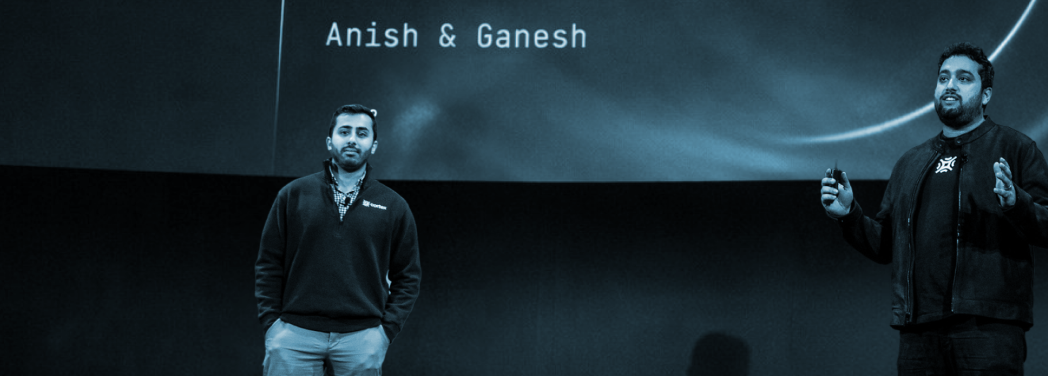
Most engineering organizations have adopted coding agents, but few have a framework for what comes next. In this keynote, Cortex founders Anish & Ganesh introduce a maturity model for the AI software factory: a multi-level progression that runs from teams using coding agents in isolation to a fully self-improving, autonomous SDLC that introspects, identifies its own weaknesses, and improves over time.
They'll discuss where most companies sit today and what separates organizations stuck at Level 1 from those moving up the curve. Throughout, they'll share how Cortex operationalizes each stage, with evidence from Cortex's own engineering team: the practices run, the gates automated, and a first look at the AI software factory Cortex runs on itself.
The Amplifier Effect: Elevating Developer Experience in the AI Era
AI’s productivity surge masks a complex reality: it shifts developer friction from writing boilerplate to a new "verification tax" of auditing machine-generated code.
AI's productivity surge masks a complex reality: it shifts developer friction from writing boilerplate to a new "verification tax" of auditing machine-generated code. DORA research reveals AI is an amplifier. It magnifies the strengths of high-performing teams, but in chaotic environments, it accelerates technical debt and cognitive load.
We will explore the AI adoption "J-Curve" to understand why early dips in flow and stability are expected. Using the DORA AI Capabilities Model, we'll show how quality internal platforms and healthy data ecosystems empower developers to focus on meaningful work.
Move beyond the hype of raw code generation. Learn to clear systemic roadblocks and build an environment where AI truly amplifies developer experience, creativity, and flow.
@inspect Fix This: Why Ramp Built it's Own Coding Agent
Ramp built Inspect, our own coding agent that's fast, secure and collaborative. It now writes 75% of all merged code, and is the backbone of our software factory. We'll talk about how it works, and using trust as the primary lever to encourage AI adoption in your organization.
From Prompt to Production: Governing AI at DevOps Speed
In this session, based on what he is doing in Fiserv, Karthik will present a practical blueprint for operationalizing AI across the Software Development Lifecycle (AI-SDLC). He will explore how to embed security, model governance, evaluation, cost management, and policy enforcement directly into developer workflows, enabling teams to move from experimentation to production with confidence.
From Onboarding to Autonomy: Blackstone's AI Journey in a Regulated Industry
Read moreBlackstone's AI journey started with a pretty ordinary goal: get new developers up to speed faster. Then coding agents showed up, and the problem got a lot more interesting. Because in a regulated industry, "move fast" and "get compliance to trust this" don't usually go together.
Blackstone's AI journey started with a pretty ordinary goal: get new developers up to speed faster. Then coding agents showed up, and the problem got a lot more interesting. Because in a regulated industry, "move fast" and "get compliance to trust this" don't usually go together. This session walks through how that tension actually got resolved, including a decision that raised some eyebrows internally: coding agents run only in cloud-based dev environments, never on endpoints. It's a tradeoff, and Blackstone will talk through why they made it. The most interesting part might be the data. When Blackstone lined up GitLab activity against AI tool usage, the productivity story wasn't what anyone expected going in. You'll walk away with a real framework for getting compliance on board with AI agents, an honest look at the endpoint tradeoff, and a better way to measure whether AI is actually helping, not just being used.
As agents absorb more of the execution across the SDLC, every service that ships faster becomes another unit to own and secure, and aggregate risk compounds well ahead of any single team's ability to see it.
As agents absorb more of the execution across the SDLC, every service that ships faster becomes another unit to own and secure, and aggregate risk compounds well ahead of any single team's ability to see it. Operational Excellence is how engineering leaders keep the system accountable: measuring where the org actually stands, catching risk before it becomes an incident, and moving people and attention to where they matter most. This panel brings together leaders who run recurring operational reviews and treat their organization as something they can observe and improve, not just react to.
Sample questions:
What does an operational excellence review look like in practice, how often should you run one, and who should be in the room?
Which signals tell you output is outpacing your ability to operate it safely?
How do you decide where to spend engineering time when everything looks urgent?
What breaks first when velocity jumps 10x, and how do you catch it early?
Modernization and Production Readiness at 10x Throughput
Migrations and modernization programs are often slow, political, and difficult to finish. AI-accelerated throughput raises the stakes: more services, more dependencies, and more code shipping.
Migrations and modernization programs are often slow, political, and difficult to finish. AI-accelerated throughput raises the stakes: more services, more dependencies, and more code shipping before anyone agrees on what "ready for production" means. This panel examines how leaders turn production readiness into a standard instead of a launch-day scramble, keep large migrations on track across dozens of teams, and modernize legacy systems without freezing delivery. Panelists share what worked, what stalled, and what they would do differently.
Sample questions:
How do you define "production-ready" so it holds as a standard, not a one-time checklist?
What makes a migration actually finish instead of stalling at 80%?
How do you keep legacy modernization moving without freezing feature work?
Where does AI-generated code create readiness gaps you didn't have before?
From Artifact Chaos to Controlled Scale: Cost, Platform & Discipline
Read moreWhen our platform crossed 5 million artifacts, the real challenge wasn't just storage volume, it was the operational complexity that came with it: too many repositories, frequent corruptions, inconsistent patterns, rising storage costs.
When our platform crossed 5 million artifacts, the real challenge wasn't just storage volume, it was the operational complexity that came with it: too many repositories, frequent corruptions, inconsistent patterns, rising storage costs, and security scanning that produced more noise than action.
In this session, I'll share our practical journey to building a leaner artifact delivery model using JFrog Artifactory with a focus on minimal configuration, controlled spend, and better developer experience. We'll cover how we simplified our repository strategy, standardized lifecycle flows, reduced custom configuration, and introduced retention discipline, by aligning them to release decisions instead of just reporting dashboards.
This is not a "perfect architecture" talk, it's a field-tested story of what worked, what didn't, and the trade-offs we had to make to scale responsibly.
The AI Spend Reckoning: Proving ROI When Your Code — and Your Bill — Is AI-Generated
Read moreAI-augmented development has not-so quietly become one of the fastest-growing line items in the engineering budget: model inference, agent fleets, copilot seats, GPU and accelerator spend.
AI-augmented development has not-so quietly become one of the fastest-growing line items in the engineering budget: model inference, agent fleets, copilot seats, GPU and accelerator spend. Most organizations still can't answer a basic CFO question: what did we get for it?
Spend is approved on faith and scrutinized a quarter later, because the instrumentation to measure return hasn't kept pace with how fast teams ship AI. "Do more with less" and "ship AI everywhere" pull in opposite directions, and reconciling them lands on engineering and platform leaders. The real cost is bigger than the token bill: AI-generated code carries a downstream load of review, security, and maintenance that few teams price in.
This roundtable convenes leaders to compare how they turn that spend into measurable efficiency: attributing cost to the teams and features that drive it, cutting the waste hiding in idle capacity and redundant calls, and knowing whether or not the investment was worth it.
How to Best Manage Critical Migrations
Read moreCareers are made, and ruined, on migrations. The technology is often the easy part. The hard part is the people, the stakeholders, the politics, and the business pressure that doesn't pause while you're mid-execution.
Careers are made, and ruined, on migrations. The technology is often the easy part. The hard part is the people, the stakeholders, the politics, and the business pressure that doesn't pause while you're mid-execution.
This roundtable is a peer conversation for engineering and platform leaders who've been in the fire. We'll go beyond the technical playbook to explore how the best leaders navigate the human and organizational complexity of migrations that truly matter. Where success or failure defines the business, and sometimes your career along with it.
Come ready to share what you've learned, what you'd do differently, and what advice you wish you'd had.
Standards Without Friction: Using Templates to Accelerate Engineering at Scale
Read moreEvery engineering org wrestles with the same tension: enough standardization to move fast, but not so much that teams feel constrained.
Every engineering org wrestles with the same tension: enough standardization to move fast, but not so much that teams feel constrained. In this roundtable, we'll explore how platform teams can use service templates, scaffolds, and golden paths to encode best practices without becoming a bottleneck. Joshua Marble, Senior Manager of DevX at Archer, will share how his team uses Cortex alongside opinionated templates to reduce the cognitive load on development teams and open the floor to discuss what's worked (and what hasn't) across our organizations.
On-call On-Point: How We Evolved to a 24/7 Support Organization
Read moreWe have had to go from zero internal support to a 24/7 on-call support operation through a combination of a new SRE team, a best-in-class incident management solution (incident.io) and a central service catalog (Cortex).
We have had to go from zero internal support to a 24/7 on-call support operation through a combination of a new SRE team, a best-in-class incident management solution (incident.io) and a central service catalog (Cortex). This talk will outline how we partnered with our vendors to implement a slick incident management operation, the pain points we solved and our future direction augmented by AI.
A fork in the road for agentic engineering - where do we go next?
Read moreThere are two approaches being taken by most orgs, either together or in a divergent manner. This round table discussion and deep dive will cover two areas to unpack the positives and negatives of both approaches.
There are two approaches being taken by most orgs, either together or in a divergent manner. This round table discussion and deep dive will cover two areas to unpack the positives and negatives of both approaches.
Organisations which are pursuing software factories - dark or guided - where the emphasis is on building the machine which builds the machine enabling non-engineers to ship and deliver new capabilities.
Software Engineers as "pilots" where humans stay in the driving seat and delivery is augmented and magnified by Agents.
Are both approaches valid and how do they interact? What has worked, and what has failed at your organisation?
Shields Up: Establishing AI Governance Before the Vibes Overrun You
Read moreVibe coding doesn't stop at the edge of your platform team - agents are writing, committing, and shipping code faster than anyone can review it, and half of them (if you're lucky) are doing it with zero adult supervision. Standing firm means a shield wall; cost caps that don't bankrupt you, approval gates that don't grind delivery to a halt, and scanning pipelines that catch the mess before it reaches prod.
Vibe coding doesn't stop at the edge of your platform team - agents are writing, committing, and shipping code faster than anyone can review it, and half of them (if you're lucky) are doing it with zero adult supervision. Standing firm means a shield wall; cost caps that don't bankrupt you, approval gates that don't grind delivery to a halt, and scanning pipelines that catch the mess before it reaches prod. This roundtable trades war stories and real-world solutions on building that governance layer — for developers and citizen developers alike — without turning your platform team into the AI police.
Operational Excellence as Code: Turning Engineering Standards into Automated Outcomes
Read moreEngineering organizations generate a wealth of operational insights across software delivery, resiliency, governance, technology modernization, and efficiency. Yet too often, these insights remain trapped in dashboards, reports, and scorecards, requiring teams to manually interpret findings, prioritize work, and address recurring issues. What if operational excellence could go beyond measurement and become a catalyst for automation?
Engineering organizations generate a wealth of operational insights across software delivery, resiliency, governance, technology modernization, and efficiency. Yet too often, these insights remain trapped in dashboards, reports, and scorecards, requiring teams to manually interpret findings, prioritize work, and address recurring issues.
What if operational excellence could go beyond measurement and become a catalyst for automation?
This roundtable explores how engineering organizations can transform operational insights into actionable initiatives and platform capabilities. Using operational excellence signals across Delivery, Resiliency, Initiatives, Vigilance, and Efficiency (DRIVE), we'll discuss how platform teams can identify systemic challenges, codify engineering standards, and leverage AI-powered automation to address them at scale.
Rather than asking every team to solve the same operational problems repeatedly, organizations can embed standards directly into their engineering ecosystem through platform integrations, automated workflows, self-service capabilities, and intelligent remediation. The result is a shift away from repetitive keep-the-lights-on activities toward strategic engineering initiatives that deliver greater business value.
Join engineering leaders, platform engineers, and practitioners to discuss:
• How operational excellence data can be translated into meaningful platform initiatives
• Identifying opportunities where automation can eliminate recurring operational effort
• Leveraging AI to detect, prioritize, and remediate engineering gaps
• Embedding governance, security, reliability, and quality standards directly into the developer workflow
• Reducing operational drag and enabling teams to focus on innovation instead of maintenance
• Building engineering platforms that continuously improve outcomes across the DRIVE framework
DRIVE Certification: Building and Running Operational Excellence Reviews
Read moreYour teams ship more code than ever, but standard metrics can't tell you if it's landing as reliable software or piling up as risk. In 45 minutes, get DRIVE-certified and watch Taylor run a live Operational Excellence review on real data.
Your teams are shipping more code than ever, and most engineering leaders are stitching together deploy frequency, MTTR, and vulnerability counts by hand to figure out if that output is actually landing as reliable, secure software — or piling up as invisible risk and tech debt. As agents write more of that code, the volume only grows, and the standard productivity metrics don't answer the question that matters: is this working?
This 45-minute session gets you DRIVE-certified and shows the framework in use. DRIVE is Cortex's framework for measuring org effectiveness, built on five pillars: Delivery, Reliability, Initiatives, Vigilance, Efficiency. Taylor will also run a live Operational Excellence review using real data and the agenda a leadership team actually uses.
You'll leave with:
DRIVE certification and a self-assessment of your org
A repeatable Operational Excellence review agenda
A plan for the metrics to track your org's maturity
Building Your Own Software Factory
Read moreLearn how Cortex's own software factory works and how you can build your own.
Learn how Cortex's own software factory works and how you can build your own.
This 45-minute session will begin with an overview of engrams, the in-house software factory built by Cortex, and how to deploy it within your organization. Learn from the experts by playing around in an open sandbox, building real AI SDLC automations. No credentials or tokens required.
You'll leave with:
Tips on how to effectively roll out your own software factory
An understanding of how to automate your SDLC